
Almost a year ago, I had a call with a SaaS founder based in Berlin.
Brilliant engineer. YC alum.
Seven hundred thousand dollars in ARR. Strong product. Smart team.
And completely stuck.
Not because of funding.
Not because of product market fit.
Not because of competition.
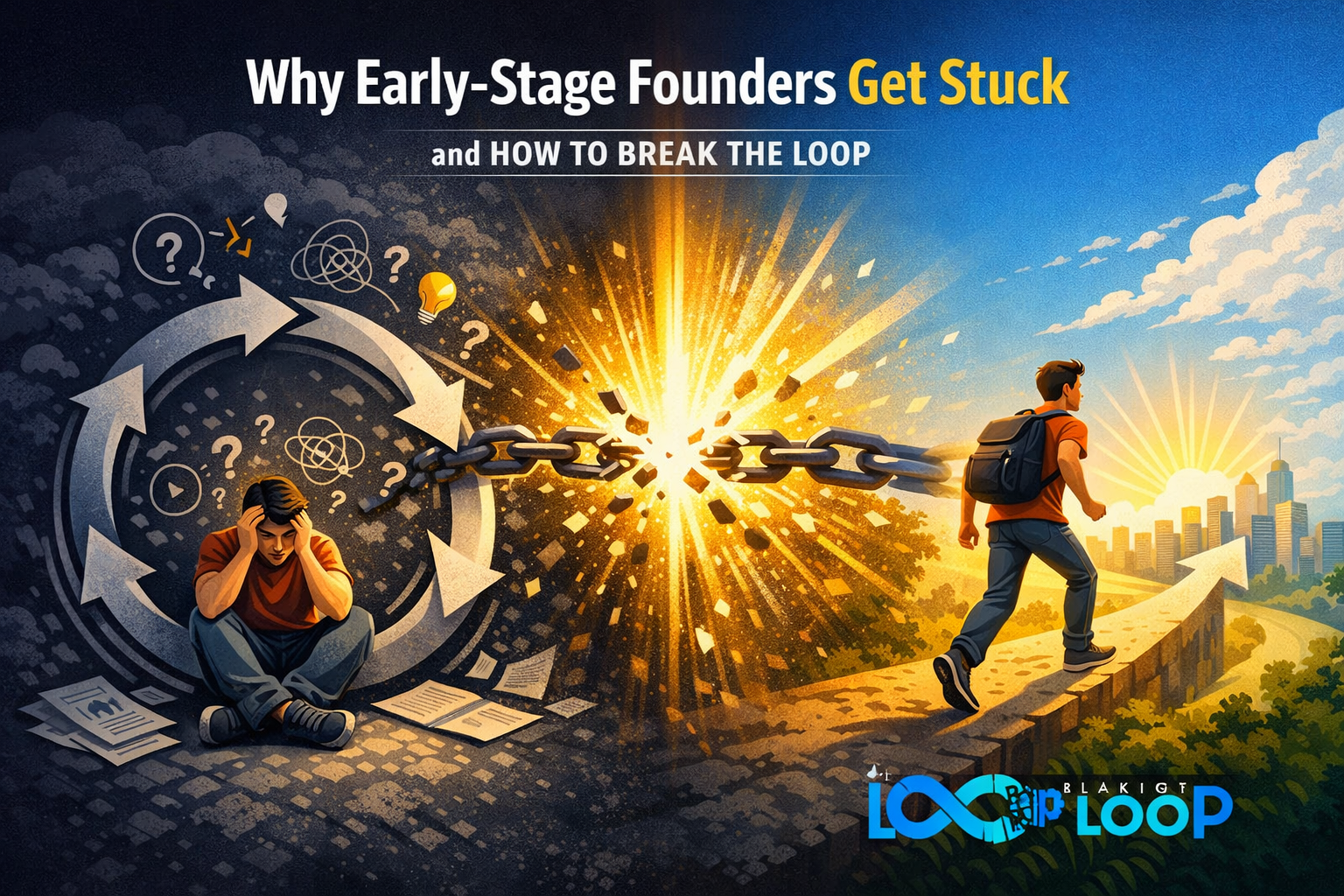
He was stuck in a loop.
Every week looked the same.
Monday. Strategic clarity. Big vision. Confident roadmap.
Tuesday. Customer feedback panic. Second-guessing positioning.
Wednesday. Rebuild roadmap. Adjust features. Reprioritize the sprint.
Thursday. Doubt everything. Compare with competitors. Scroll LinkedIn.
Friday. Maybe we should pivot.
Sunday night. Anxiety spikes before the week even begins.
Nothing catastrophic was happening.
Revenue was steady. Churn was manageable. The team was capable.
But internally, there was constant turbulence.
And that is the dangerous part.
Because the loops that kill founders are rarely dramatic. They are not explosive failures or public collapses. They are repetitive. Subtle. Rationalized.
And they compound quietly.
Over time, these loops do not just slow growth. They reshape the founder. Confidence erodes. Decision velocity drops. The company begins to mirror the internal instability of its leader.
What Is a Cognitive Loop
A cognitive loop is a repeated thought pattern that drives behavior, even when that behavior no longer serves you.
Founders do not fail because they lack intelligence.
They fail because they unknowingly automate flawed mental cycles.
Especially in tech ecosystems across the United States and Europe, I see this repeatedly among:
First-time SaaS founders navigating their first real scale phase
Technical founders transitioning into CEO roles
Bootstrapped operators scaling past five hundred thousand to two million in ARR
Seed stage founders operating under investor pressure
The pattern is consistent across Berlin, London, New York, Austin, Stockholm, and Amsterdam.
High intelligence. High ambition. Hidden psychological repetition.
Let us break down the most dangerous loops.
Loop One: The Optimization Trap
Symptom. Constant tweaking. No compounding.
You improve the onboarding flow.
You refine the pricing page.
You rewrite the landing copy.
You redesign the dashboard UI.
You upgrade the CRM workflow.
But revenue barely moves.
Psychologically, this makes sense.
Your brain prefers optimization over uncertainty.
Optimization feels productive. It gives you control. You can measure it. You can ship it.
Strategic risk feels dangerous. Changing positioning. Narrowing your ICP. Raising prices significantly. Killing a feature. Those decisions carry emotional weight.
So instead, you adjust small levers.
I have seen founders spend four months optimizing conversion rates from two percent to two point three percent when the real issue was weak differentiation in a crowded market.
Ask yourself honestly.
Am I improving mechanics or solving the real bottleneck?
Elite founders diagnose before they optimize. They zoom out before they zoom in. They ask what constraint actually limits growth rather than polishing what is already functioning.
Loop Two Motion Masquerading as Progress
Calendar full. Slack active. Investor updates polished.
But strategically stagnant.
The brain rewards activity. There is dopamine in busyness. In tech culture, especially in the United States, motion is often mistaken for ambition.
But growth compounds from leverage, not from activity.
More calls do not equal more progress.
More Slack messages do not equal more clarity.
More dashboards do not equal better decisions.
I once worked with a London-based fintech founder who was in meetings from eight in the morning until seven in the evening. When we audited his calendar, more than half of his meetings had no long-term strategic impact.
He was not leading.
He was reacting.
Founders must transition from operator to architect. And architecture requires space. White space on the calendar. Strategic solitude. Thinking time without notifications.
Without that shift, motion consumes the day, and progress never compounds.
Loop Three Identity Conflict
This one hits technical founders hardest.
You start as a builder. A problem solver. A product brain.
Then growth forces a transformation. You must become a recruiter. A vision carrier. A capital allocator. A culture setter.
Your company grows faster than your identity evolves.
So what happens?
You retreat into competence.
Back into code. Back into product debates. Back into feature discussions.
Because that is where you feel intelligent and in control.
But at scale, leverage sits in people and strategic clarity.
This internal conflict creates friction. You delay senior hires because no one feels good enough. You micromanage because delegation feels risky. You distrust non-technical roles because you cannot measure their output as cleanly as code commits.
It is not ego.
It is identity lag.
Scaling requires a self-upgrade. The founder must expand psychologically before the company can expand structurally.
Loop Four External Validation Dependence
In venture ecosystems across the US and Europe, validation is everywhere.
Investor praise. Social media applause. Public traction updates. Conference invitations. Press mentions.
The subtle shift happens when you begin building for applause instead of building for durability.
The loop is simple.
Share traction.
Get praise.
Feel validated.
Chase the next visible milestone.
But validation is not traction. Visibility is not resilience. Funding is not product-market fit.
I have seen founders celebrate funding rounds while privately admitting their unit economics were fragile.
External applause delays internal reckoning.
And reckoning always comes.
When market conditions tighten, when growth slows, when investors push harder, the company built on validation begins to shake.
Loop Five Decision Paralysis Disguised as Strategic Thinking
Over-analysis. Scenario mapping. Contingency stacking.
It sounds intelligent. It sounds responsible.
But sometimes it is the fear of wearing a suit.
There is a difference between thoughtful and avoidant.
A founder once told me he just needed two more weeks of data before committing to a pricing shift.
Two weeks became three months.
A competitor shipped aggressively. The market narrative shifted. Momentum died.
Speed with imperfect clarity beats perfect clarity too late.
In dynamic tech markets, especially in cities like San Francisco, London, and Berlin, timing is strategic leverage. Delay quietly erodes advantage.
Why These Loops Are Dangerous
Because they do not feel wrong.
They feel responsible.
They feel thoughtful.
They feel productive.
They feel strategic.
But slowly, they drain energy. They erode confidence. They blur direction. They exhaust teams.
Over time, the founder becomes the bottleneck.
Not because of incompetence.
Because of unexamined patterns.
And here is the uncomfortable truth. The company rarely outgrows the psychology of its leader.
How to Break the Loop: The Founder Reset Framework
Awareness is the beginning. Structure is the solution.
Step One: Identify the Recurring Pattern
Write down what you keep revisiting every two to three weeks.
What decisions do you repeatedly re-decide?
Where do you feel the same emotional tension cyclically?
Patterns reveal loops.
Step Two: Name the Loop
Give it a label. The Optimization Trap. The Validation Cycle. The Avoidance Spiral.
Naming reduces emotional intensity. What is named can be managed.
Step Three: Locate the Fear Beneath It
Every loop protects you from something.
Fear of failure.
Fear of irrelevance.
Fear of losing control.
Fear of being exposed as not good enough.
Founders in tech are brilliant at solving external problems. But rarely do they audit their internal architecture with the same rigor.
Step Four: Install a Pattern Interrupt
Insight alone does not break loops. Structure does.
Create a forty-eight-hour decision rule for reversible decisions.
Lock roadmap changes to fixed review cycles.
Conduct a calendar audit every thirty days.
Schedule one strategic off-site day per month without meetings or notifications.
Loops break when systems change.
Final Reflection
If you feel constantly busy but strategically foggy.
If you feel smart but are second-guessing.
If you feel growth but also exhaustion.
If you feel surrounded yet isolated.
You are not weak.
You are likely looping.
And loops remain invisible until they are consciously examined.
The real shift in founder maturity is not revenue. It is awareness. It is emotional regulation under pressure. It is the ability to notice your own patterns before they calcify into culture.
So ask yourself honestly.
What loop am I protecting that is quietly limiting my company?
That question, answered truthfully, is often the beginning of real scale.